Declutter Kitchen Without Burning Out: A Calm, Clear Way to Reset the Heart of Your Home
A steady, low-pressure approach to decluttering your kitchen when you’re tired of all-or-nothing cleanups, overflowing counters, and decisions that never seem to end.
If your kitchen feels like it’s always one step away from chaos, you’re not alone. The kitchen collects more than items. It collects timing issues, half-finished intentions, and the daily rush of real life.
This article is a gentle way to think through a kitchen declutter without turning it into a weekend event or a personality test. Nothing here requires you to be decisive on demand. You can move slowly. You can pause. You can read this and do nothing today.
A cluttered kitchen doesn’t mean you’re doing anything wrong. It usually means the kitchen is working hard.
And when a room works hard, it needs fewer obstacles, not more pressure.
Start by naming what “clutter” means in a kitchen
Kitchen clutter is different from bedroom clutter. In a kitchen, the problem is rarely “too many things” in a general sense. It’s more often “too many things competing for the same few inches of space.”
That competition shows up in small, familiar ways: counters you can’t set anything down on, drawers that catch, a cabinet that avalanches when you open it. It can also show up as mental noise. You keep thinking about the kitchen, even when you’re not in it.
So before you remove anything, it helps to name what counts as clutter in this room.
In most kitchens, clutter falls into a few quiet categories:
- Things you use, but not in the place you reach for them
- Things you don’t use, but keep maintaining anyway
- Things you can’t put away because “away” is already full
This isn’t about judging the items. It’s about noticing friction. When the kitchen is cluttered, the room asks you to make extra decisions all day long. That’s what wears people down.
Once you see clutter as daily decision pressure, the goal shifts. You’re not trying to own less for its own sake. You’re trying to make the kitchen easier to live with.
Choose one small “relief zone” instead of starting everywhere
A kitchen declutter can feel impossible because the room is interconnected. You clear one counter, and the stuff lands somewhere else. You open one cabinet, and you remember three other problems.
That’s why starting with the whole kitchen is often the fastest way to stop.
Instead, pick a relief zone. A relief zone is a small area that, once calmer, makes the kitchen feel less heavy even if nothing else changes yet.
Good relief zones are usually:
- One counter corner where you prep or make coffee
- One drawer you open every single day
- The space right around the sink
The point isn’t that this zone is the most important area. The point is that it’s reachable. And reachable spaces are where momentum comes from, without you having to force it.
A relief zone also has a boundary. You can finish it. You can stop. That matters more than people realize.
When you keep the starting area small, you avoid the “everything is out” stage that makes kitchens unusable mid-declutter. You also protect your energy. This is usually where people quietly get stuck: they choose a project size that requires a version of them that isn’t available right now.
A relief zone lets you work with the version of you that exists today.
Clear the counter by separating “needs a home” from “needs a decision”
Counters are where kitchens show their stress. They become the default landing pad for everything that doesn’t have an obvious place to go.
If you try to declutter a counter by making decisions item-by-item, it turns into an emotional gauntlet. You’ll bump into “I should use this,” “Why do I own three of these,” and “I don’t know where to put it,” all in the same minute.
A calmer approach is to separate two kinds of counter clutter:
Items that need a home. These are things you already want to keep. They just don’t have a reliable spot.
Items that need a decision. These are the “maybe” items. Duplicates, awkward gadgets, random pantry overflow, half-broken tools, and things you keep moving from pile to pile.
For now, don’t solve everything. Just sort into two small groupings. This matters because “find a home” and “make a decision” use different mental energy.
Finding a home is practical. Decision-making is emotional and cognitive.
When you mix them, the process feels harder than it has to be. When you separate them, the counter starts to look clearer quickly, and your brain settles.
Once the counter is grouped, choose only one path at a time. Either put away the “needs a home” items first, or set aside the “needs a decision” items for a later section of the kitchen. The counter doesn’t need you to be brave. It needs you to be consistent.
Declutter cabinets by clearing shelf “traffic,” not chasing perfection
Kitchen cabinets can hold a surprising amount of tension because they’re hidden. You can close the door and pretend things are fine—until you need something quickly.
A useful way to declutter cabinets is to think in terms of shelf traffic.
High-traffic shelves are the ones you reach for every day. Low-traffic shelves are the ones you open once a month, or only when you’re hosting, baking, or doing something seasonal.
Clutter happens when low-traffic items creep into high-traffic space. You end up moving a rarely-used appliance just to reach plates. Or you keep a stack of mismatched containers on the shelf where you want to grab lunch items.
So the goal is simple: protect the high-traffic shelves.
Start by opening one cabinet and noticing what blocks access to your daily items. Those blockers are often:
- Extra mugs and glasses
- Large serving pieces
- Bulky appliances you don’t truly use
- Backstock pantry items that don’t fit elsewhere
You don’t have to decide their final fate right away. You can simply move blockers out of the high-traffic zone and into a temporary holding spot, like a box or an empty section of counter.
Then, give the high-traffic shelf a clean, simple layout. The most-used items should be easy to see and easy to lift out.
This isn’t about showroom cabinets. It’s about not needing two hands and a deep sigh to get a bowl.
Handle “too many duplicates” without turning it into a moral issue
Kitchen duplicates are common, and they’re also strangely loaded. People feel guilty about owning them, or defensive about why they need them, or embarrassed that they didn’t notice how many they had.
But duplicates aren’t a character flaw. They usually happen for predictable reasons: you couldn’t find the first one, you bought a backup during a busy week, someone gave you one, or you upgraded and never dealt with the older version.
The key is to treat duplicates like a space problem, not a personal problem.
When you find duplicates, you can ask calmer questions than “Why do I have this?”
Try:
- Which one do I reach for without thinking?
- Which one fits the space I actually have?
- Which one makes the task feel easiest?
Often, the best item isn’t the newest or the most expensive. It’s the one that works smoothly in your hands.
If you’re not ready to donate or discard duplicates immediately, you can still reduce daily clutter by choosing one “active” version and placing the others in a separate, contained spot for now. That alone protects your drawers and counters.
Duplicates become stressful when they create friction every day. When the extra versions are out of your daily path, the kitchen feels lighter even before you’ve made final decisions.
Make drawer space match how you actually move
Kitchen drawers tend to fill according to availability, not logic. If there’s room, something goes in. Over time, the drawer stops reflecting how you cook or prepare food and starts reflecting a series of rushed decisions.
A calmer way to declutter drawers is to look at them through movement instead of categories.
Pay attention to what your hands do without thinking. Where do you stand when you make coffee? Where do you reach when you pack lunch? Which drawer do you open while the stove is already on?
Those movements matter more than traditional organizing rules.
If your most-used utensils are split across three drawers because “that’s where they fit,” the drawer system is working against you. The goal isn’t symmetry. It’s ease.
When you empty one drawer at a time, notice which items interrupt your natural flow. These are often tools you technically use, but not daily, or items that belong to a different task entirely.
You can quietly remove friction by letting one drawer serve one primary motion. Stirring. Cutting. Packing. Measuring.
This may mean relocating items that “should” live there according to past logic. That’s okay. Drawers don’t need to make sense to anyone else.
Once a drawer matches your movement, it stops feeling cluttered even if it’s still full. That’s because your brain recognizes the pattern and stops scanning for alternatives.
Ease comes from alignment, not minimalism.
Approach pantry clutter as a visibility issue first
Pantries rarely feel cluttered because of quantity alone. They feel cluttered because things disappear.
When you can’t see what you have, you buy duplicates. When you buy duplicates, shelves overfill. When shelves overfill, items get shoved to the back, and the cycle continues.
Before you decide what stays or goes, focus on visibility.
This doesn’t require matching containers or a full reset. It starts with clearing just enough space to see categories again.
Choose one shelf. Pull everything out. Then place items back with the labels facing forward and similar items grouped loosely together. Don’t worry about perfect rows.
As you do this, notice which items keep blocking your view. Tall boxes. Half-used bags. Bulk purchases that don’t fit the shelf depth.
Those blockers don’t need to leave the house yet. They just need a different placement. Sometimes moving them to a lower shelf or a bin restores visibility immediately.
When you can see what you have, your relationship with the pantry shifts. You stop managing it defensively.
Clutter decisions become easier after visibility improves because you’re no longer guessing. You’re responding to what’s actually there.
A visible pantry is calmer than a “perfect” one, and it’s a more stable place to pause before making bigger changes.
Let go of the idea that every item needs a perfect category
One reason kitchen decluttering stalls is the pressure to categorize everything correctly. People worry about whether an item belongs in prep, storage, baking, or serving. That pressure creates hesitation.
In real kitchens, items don’t live in categories. They live in reach zones.
If you use a bowl for mixing, serving, and leftovers, it doesn’t need to be assigned a role. It needs a spot where you’ll look for it.
When you’re decluttering, it’s enough to ask: “Where would I look for this first?”
That answer is usually simple. And it’s usually more accurate than any system.
You might place snacks near the door instead of in the pantry. You might keep measuring cups near the coffee area instead of baking supplies. You might store oils closer to the stove than logic diagrams suggest.
This isn’t disorganization. It’s adaptation.
When you release the need for perfect categories, you reduce decision fatigue. Items find homes faster. Cabinets stay calmer because you’re not constantly rearranging to fit an ideal.
The kitchen becomes responsive instead of rigid.
That responsiveness is what makes a declutter last. Not because everything is labeled, but because the space bends to your real habits instead of resisting them.
Address “aspirational items” without forcing a decision
Every kitchen has aspirational items. The bread maker you thought you’d use more. The specialty pans. The tools tied to a version of life that hasn’t had room yet.
These items are often the hardest to declutter because the question isn’t about use. It’s about identity and timing.
A gentle way to handle aspirational items is to give them a defined pause instead of a verdict.
Choose a single cabinet, shelf, or bin as an “optional use” space. This space holds items you’re not ready to let go of, but also don’t need in your daily path.
Moving aspirational items out of high-traffic areas does two important things. It reduces daily clutter, and it removes the quiet pressure of seeing them every time you cook.
When they’re not in your way, you can relate to them more honestly.
Over time, one of three things usually happens. You start using an item because space made it possible. You realize you haven’t thought about it at all. Or you reach a natural readiness to release it.
None of those outcomes need to be rushed.
Decluttering doesn’t require you to grieve potential all at once. It works better when it respects pacing.
Maintain progress by protecting empty space
One of the most overlooked parts of decluttering a kitchen is what happens after something is cleared.
Empty space feels temporary to many people. There’s a subtle urge to fill it, justify it, or make it “useful.”
But empty space is not wasted space. In a kitchen, it’s functional.
An empty shelf allows for overflow during busy weeks. An open counter corner gives you room to breathe while cooking. A half-empty drawer absorbs new items without tipping into chaos.
To make decluttering stick, it helps to quietly protect some emptiness.
This doesn’t mean declaring a drawer off-limits. It means noticing when you’re about to fill space just because it exists.
You can pause and ask, “Is this space solving a problem for me right now?”
If the answer is yes, leave it.
Empty space acts like a buffer. It softens daily life. It keeps small disruptions from becoming full resets.
When you allow your kitchen to have breathing room, you reduce the need for frequent declutters. The room becomes more forgiving.
That forgiveness is often what people are actually seeking when they say they want an organized kitchen.
Declutter under the sink by reducing “maintenance clutter”
The space under the kitchen sink often holds the most mentally draining kind of clutter. Not because there’s too much, but because everything there represents upkeep. Cleaning supplies, backups, tools for problems you hope won’t happen.
This is maintenance clutter. It carries future responsibility.
A calmer way to declutter this area is to separate what you actively use from what you’re maintaining “just in case.”
Start by pulling everything out and placing it into three loose groups:
- Items you use weekly
- Items you use occasionally
- Items you’re maintaining without a clear pattern
Weekly-use items earn the most accessible space. They should be easy to grab without moving anything else.
Occasional-use items can live further back or higher up, still visible but not in your way.
The third group is where pressure lives. Old cleaners you don’t love. Half-used products that didn’t quite work. Tools you’ve replaced but kept anyway.
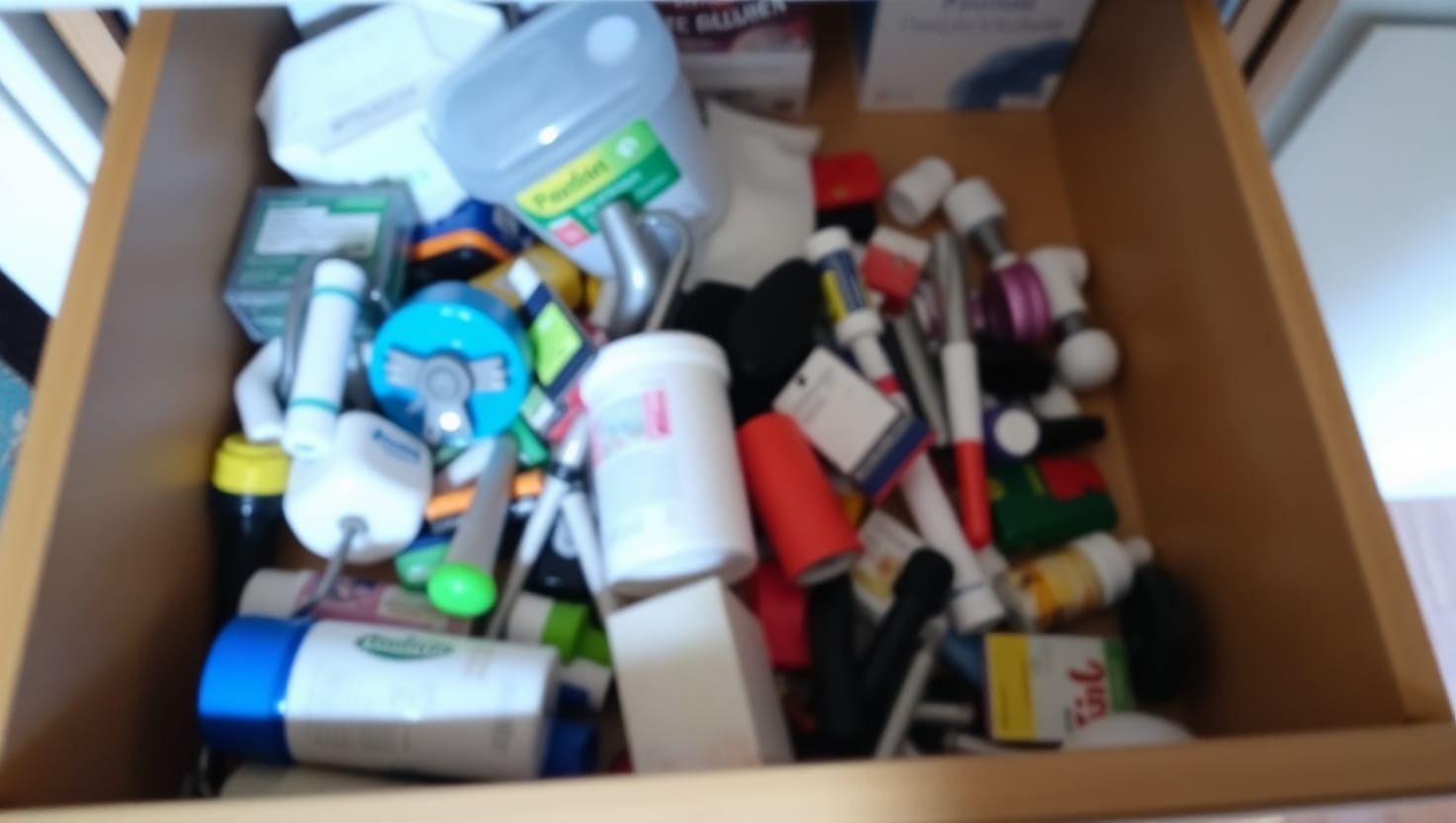
You don’t need to decide their fate immediately. You can contain them into a single bin or small box. That containment alone reduces friction.
When maintenance clutter is scattered, it feels endless. When it’s grouped, it becomes manageable.
The goal isn’t an empty cabinet. It’s a cabinet that doesn’t quietly ask you to take care of things you’re not ready to deal with yet.
Soften the emotional weight of inherited or gifted items
Many kitchens carry items that didn’t start with you. Dishes from relatives, cookware from earlier stages of life, gifts chosen with good intentions.
These items are often kept out of respect rather than usefulness. Over time, they blend into the background and add weight without adding ease.
Decluttering these items doesn’t require a dramatic decision. It starts with acknowledgment.
You can quietly notice which inherited or gifted items you actually reach for. Those that are used have already earned their place.
For the rest, it helps to separate the object from the relationship it represents. Keeping an item is not the same thing as honoring a person.
If an item makes daily tasks harder, that friction matters too.
A gentle approach is to choose one representative piece to keep visible, while allowing the rest to move out of prime kitchen space. They can be stored elsewhere, donated thoughtfully, or released later when readiness arrives.
This isn’t about minimizing sentiment. It’s about letting your kitchen support your current life.
When emotional items stop interrupting daily function, the room feels lighter without feeling stripped.
Respect can coexist with practicality. The kitchen doesn’t need to carry every memory to hold meaning.
Notice how clutter returns before trying to stop it
After some decluttering, clutter often creeps back in. This can feel discouraging, but it’s actually useful information.
Returning clutter usually points to a mismatch between storage and real life, not a lack of discipline.
Instead of trying to prevent clutter entirely, observe how it returns.
Does mail collect on the counter because there’s no easy landing spot? Do snacks pile up because the pantry shelf is too high for daily use? Do tools end up in the wrong drawer because it’s closer to where you stand?
These patterns are not problems to correct. They’re data.
When you notice where items naturally land, you learn how your kitchen wants to function. You can then adjust storage to meet that behavior instead of fighting it.
A small basket, a shifted drawer assignment, or a cleared corner can redirect clutter without effort.
This approach removes blame from the process. The kitchen becomes a responsive system instead of a test you keep failing.
Decluttering sticks longer when it adapts to you, not when it asks you to adapt to it.
Allow some areas to stay “good enough” on purpose
One of the quiet traps of kitchen decluttering is the belief that every area should reach the same level of order.
In reality, some zones are always going to be messier because they carry more activity. The snack drawer. The fridge door. The counter near the stove.
Trying to make these areas pristine often creates more stress than benefit.
A calmer approach is to intentionally decide which areas only need to be “good enough.”
Good enough might mean:
- Items fit without jamming
- You can see what you have
- Nothing falls out when opened
That’s it.
When you stop pushing high-use areas to look calm instead of function calmly, you free up energy for the parts of the kitchen that benefit more from structure.
This also reduces the sense that the kitchen is never finished. Some areas are allowed to fluctuate. That permission matters.
Decluttering isn’t about uniform order. It’s about distributing effort where it actually helps.
When “good enough” is chosen on purpose, it feels stable instead of sloppy.
Let the kitchen settle before changing anything else
After working through multiple areas of the kitchen, there’s often an urge to keep going. To tweak, adjust, or start over because it’s not quite right yet.
This is usually the moment when rest is more useful than refinement.
A kitchen needs time to reveal whether changes truly work. Daily routines have to run through the space a few times before you can see what holds and what doesn’t.
Letting the kitchen settle means living with it as-is for a while. Cooking. Cleaning. Moving through it without actively fixing.
During this phase, clarity tends to surface on its own. You’ll notice what still feels heavy and what quietly resolved itself.
Many issues sort themselves out when pressure lifts.
Pausing here isn’t giving up. It’s allowing integration.
Decluttering that lasts is often built on these pauses. They prevent overcorrection and burnout.
You don’t need to finalize the kitchen to move forward. You just need to let it be livable long enough to trust what you’ve already changed.
When decluttering stops feeling temporary
Many people reach a point where the kitchen feels better, but also fragile. Like one busy week could undo everything. That feeling isn’t a failure of effort. It’s usually a sign that the deeper pattern hasn’t been addressed yet.
Decluttering sticks when it stops being a series of resets and starts fitting into how your life actually moves. Not as a system to maintain, but as a way of relating to your space with less resistance.
If you’ve ever wondered why some progress fades while other changes quietly hold, that question is worth staying with. Sometimes the shift isn’t in the room at all.